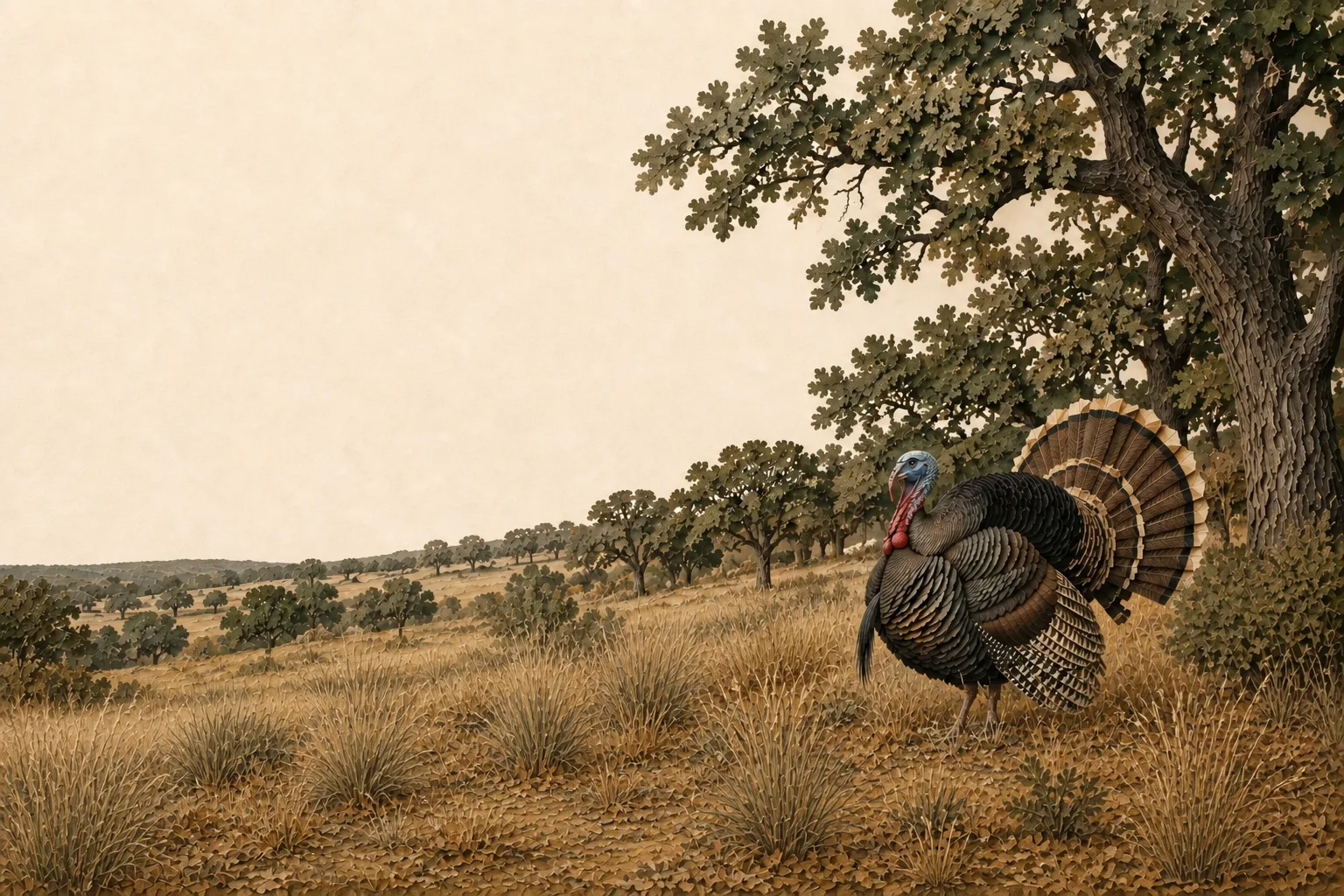
Illustrated Cross Timbers post oak woodland and native prairie with a wild turkey.

Cross Timbers & Prairies Ecoregion

Eastland County Wildlife Exemption

How to get - and keep - a 1-d-1 wildlife management valuation on Eastland County land: deadlines, the appraisal district, and the practices that fit this part of Texas.

Ecoregion
Cross Timbers & Prairies
County seat & CAD
Eastland, Texas
Application window
January 1 – April 30
Core requirement
Form 50‑129 + PWD‑885 · 3 of 7 qualifying practices annually

The wildlife exemption in Eastland County

In Eastland County, more landowners convert to wildlife management every year - keeping the low taxes of an ag valuation while managing white-tailed deer and Rio Grande turkey instead of cattle. The county lies in the Cross Timbers & Prairies ecoregion, and that shapes exactly what your management plan should look like.

The Cross Timbers and Prairies region alternates bands of post oak and blackjack oak woodland with limestone prairies, stretching west and south of the DFW Metroplex. It is prime "ranchette" country: properties of 20–200 acres where owners are converting from marginal cattle operations to wildlife management as land prices and fragmentation make grazing impractical.

Deer numbers are strong throughout the Cross Timbers, and Rio Grande turkeys travel the oak creek corridors - properties that protect roost trees and manage brush strategically score well on management plans here. Typical target species for Eastland County plans include white-tailed deer, Rio Grande turkey, bobwhite quail, painted buntings, and mourning dove. The recurring habitat challenges - juniper and mesquite encroachment on prairies, overgrazed rangeland recovering slowly, and rapid fragmentation near the Metroplex - are what a good management plan turns into qualifying work.

On the ground in Eastland County

Eastland and Ranger sit on I-20 in old oil-and-oak country where post oak, mesquite, grass, tanks and brushy draws still define much of the rural land. Wildlife management often comes down to maintaining the right pattern: enough open native grass and forbs for feeding, enough brush and oak for shelter, protected water and creek corridors, and repair around disturbed ground. An Eastland County wildlife plan can fit naturally on a former cattle or mixed-use ranch without pretending livestock must disappear for the habitat work to be real.

Eastland County lies in the Cross Timbers & Prairies and is assigned to TPWD's Cross Timbers and Prairies wildlife-use appraisal region - the legal map that sets the reduced-tract acreage rule below.

Is there an acreage minimum in Eastland County?

Did the tract get smaller since January 1 of last year?

No ➔

There is no wildlife acreage test in Eastland County at all. Whatever the size, file Comptroller Form 50‑129 with a PWD‑885 plan. A 7-acre tract that already carried 1‑d‑1 (ag exempt) and was never split can convert with no penalties.

Yes ➔

The Eastland County appraisal district has published its figure. The legal minimum land requirement is 14.3 acres (93%). Wildlife management property associations, and land designated as habitat for a special listed species: 11.1 acres (91%).

Source: Eastland County Appraisal District Agricultural Land Qualification Guidelines, December 11, 2025.

Try It Out Risk-Free

See how Eastland County compares: minimum acreage for all 254 Texas counties →

How it works here

Eastland County follows the statewide 1-d-1 framework (Texas Tax Code §23.51(7)); the local variables are your appraisal district's filing habits and the Cross Timbers & Prairies intensity standards:

  • Start from an existing ag or timber valuation. Wildlife management is a conversion of qualified open-space land - check eligibility if your status is unclear.
  • File a wildlife management plan (TPWD form PWD‑885) with the Eastland County appraisal district, attached to Comptroller Form 50‑129, between January 1 and April 30. What goes in the plan →
  • Perform at least 3 of the 7 practices each year at Cross Timbers & Prairies intensity levels - see the local examples below.
  • Document everything - dates, photos, quantities. When the chief appraiser requests an annual report (PWD‑888), you'll answer with records, not recollections.
  • No minimum acreage applies unless your tract got smaller since January 1 of last year. If it did, Eastland County's figure is covered above - the district picks one number for the whole county, and the plan is still the application either way.

The 7 practices, Cross Timbers & Prairies-style

These are the kinds of activities appraisal districts in the Cross Timbers & Prairies recognize as real management - your plan picks at least three. The Cross Timbers & Prairies region guide covers the species, habitat problems and intensity standards behind them.

1

Habitat control

Cedar and mesquite control on prairie openings, prescribed burning to hold back brush, and native grass re-establishment on old bermudagrass fields.

2

Erosion control

Brush sediment traps in draws, re-seeding eroded caliche slopes, and stabilizing pond dams and spillways.

3

Predator control

Feral hog trapping, targeted coyote management during fawning, and raccoon control around turkey roosts and quail nests.

4

Supplemental water

Converting stock tanks for wildlife with ramps and shallow zones, installing guzzlers on dry divides, and protecting seeps and springs.

5

Supplemental food

Winter wheat and oat food plots, strip-disking for native forbs, half-cutting mesquite to stimulate browse, and protecting oak mottes.

6

Providing shelter

Brush piles from cleared cedar, plum thicket establishment for quail coveys, and retaining large roost trees along creeks for turkeys.

7

Census counts

Spotlight surveys, trail camera censuses at 1 camera per 100 acres, spring gobbler counts, and quail covey call surveys.

Filing & the appraisal district

DateWhat happens in Eastland County
January 1Valuation date - land is judged on its use and qualification as of this day.
Jan 1 – Apr 30File Form 50‑129 with your PWD‑885 plan at the Eastland County appraisal district (Eastland).
After Apr 30Late applications accepted until the appraisal roll certifies, with a 10% penalty on that year's savings.
On requestThe chief appraiser may require a PWD‑888 annual report - many districts ask annually. Keep logs so the answer is one click away.

The Eastland County appraisal district is headquartered in Eastland. For current mailing addresses, phone numbers, and any locally adopted wildlife-use ratio, use the Texas Comptroller's county directory - and confirm details before filing; districts occasionally adjust procedures year to year.

The cost of letting it slip

Losing qualification means market-value taxes going forward - and if the land's use changes to non-agricultural, rollback taxes: the previous three years of tax savings, recaptured in one bill. On typical Eastland County acreage that's easily five figures. How rollback works →

Eastland County questions

Eastland County wildlife exemption FAQ

The questions Eastland County landowners ask most - answered against this county’s appraisal district and the Cross Timbers & Prairies standards its plans are judged by.

How many acres do you need for a wildlife exemption in Eastland County?
For most tracts, there is no minimum at all. Eastland County applies no acreage test to wildlife management use unless your tract was reduced in size since January 1 of the preceding year. If it was, the Eastland County appraisal district applies the figure it has adopted: 14.3 acres (93%). The district sets 11.1 acres (91%) for land in a wildlife management property association. A tract that was never split can convert at any size, so long as it already carries a 1‑d‑1 (ag exempt) valuation. Source: Eastland County Appraisal District Agricultural Land Qualification Guidelines, December 11, 2025.
What is the wildlife exemption filing deadline in Eastland County?
April 30. The window opens January 1 and closes April 30 - file Comptroller Form 50‑129 with a TPWD PWD‑885 wildlife management plan attached at the Eastland County appraisal district in Eastland. Miss it and the district still accepts a late application until the appraisal roll certifies (typically mid-July), but with a 10% penalty on that year’s tax savings. One trap catches new owners every year: buying land that already holds the valuation does not carry it over to you - you have to file your own application.
Do I need an existing ag exemption to get a wildlife exemption in Eastland County?
Yes. Wildlife management is a qualifying use within the 1-d-1 open-space valuation, not a separate exemption - so the land has to already carry an agricultural or timber productivity valuation on the day you convert. If it does, converting changes the qualifying activity and nothing else: the productivity value carries over from your previous ag category, so your tax bill does not move. If the land lost its valuation, you would requalify the ordinary way first - agricultural use for 5 of the preceding 7 years - and then convert. The conversion playbook →
Which wildlife management practices qualify in Eastland County?
Any three of the seven named in Texas Tax Code §23.51(7): habitat control, erosion control, predator control, supplemental water, supplemental food, providing shelter, and census counts. The list is statewide, but the standard you are judged against is regional - Eastland County is Cross Timbers & Prairies country, so the Eastland County appraisal district expects work sized to Cross Timbers & Prairies intensity levels and aimed at the problems that actually limit wildlife here: juniper and mesquite encroachment on prairies, overgrazed rangeland recovering slowly, and rapid fragmentation near the Metroplex. Habitat control, supplemental water, and census counts are the most common opening three. See what each one looks like here →
What species should an Eastland County wildlife management plan target?
Whatever you name, it has to be indigenous - Texas Tax Code §23.51(7) qualifies land used to sustain a breeding, migrating, or wintering population of native wild animals, and that is the species test that actually decides qualification. In the Cross Timbers & Prairies, plans are usually built around white-tailed deer, Rio Grande turkey, bobwhite quail, painted buntings, and mourning dove. Deer numbers are strong throughout the Cross Timbers, and Rio Grande turkeys travel the oak creek corridors - properties that protect roost trees and manage brush strategically score well on management plans here. Introduced species are the common trap: exotics like axis deer or blackbuck may live on the property, but managing for them (alone) earns you nothing toward your three practices - so confirm every species you name in the plan is native to Texas before you file.
Does Eastland County require a PWD-888 annual report every year?
The chief appraiser may require one whenever they ask - that is the statutory standard, and many Texas districts ask annually or on a review cycle. The practical answer is to assume it is coming: keep dated records, photos, and quantities for every practice as you go, and the report is a formality instead of a scramble. Landowners rarely lose a valuation because the work was not done; they lose it because the work could not be proven. What a strong PWD‑888 looks like →
Will switching from cattle to wildlife trigger rollback taxes in Eastland County?
No. Rollback under Texas Tax Code §23.55 is triggered by a change to a non-agricultural use - developing, paving, or subdividing the land. Moving from grazing to wildlife management is a change of use within 1-d-1, so the valuation continues uninterrupted and no recapture is owed. What does carry risk is letting the land go idle: land quietly used for nothing agricultural can be treated as having changed use. A documented wildlife plan is precisely how you stay out of that gray zone. How rollback works →
Who approves the wildlife exemption in Eastland County - TPWD or the appraisal district?
The appraisal district. The Eastland County appraisal district’s chief appraiser reviews your Form 50‑129 and PWD‑885 plan and decides whether the land qualifies, the same as for any agricultural application. Texas Parks & Wildlife publishes the forms and the ecoregion guidelines your plan should match, but it does not approve individual properties and has no vote on your valuation. The district is headquartered in Eastland; current contact details are in the Texas Comptroller’s county directory.

Looking for the statewide picture? The full Texas wildlife exemption FAQ covers eligibility, plans, practices, reports, and rollback in depth.

The Cross Timbers & Prairies counties closest to Eastland County - same ecoregion, same intensity standards, and largely the same ground:

Rio Grande wild turkey and northern bobwhite quail among native Texas grasses and limestone

Protect your Eastland County valuation.

Bring your previous report and field records. Keep this year’s practices, county feedback, and next PWD‑888 together.

No credit card required · Start free, upgrade when ready