Texas ecoregion · 30 counties

Pineywoods wildlife management

Pine-hardwood forest, bottomland sloughs, and timber country transitioning to wildlife.

Counties
30 of 254
Flagship species
White-tailed deer and eastern wild turkey
Appraisal regions
2 · 12.5–16.7 ac
Districts publishing a figure
5 of 30

The Pineywoods on the ground

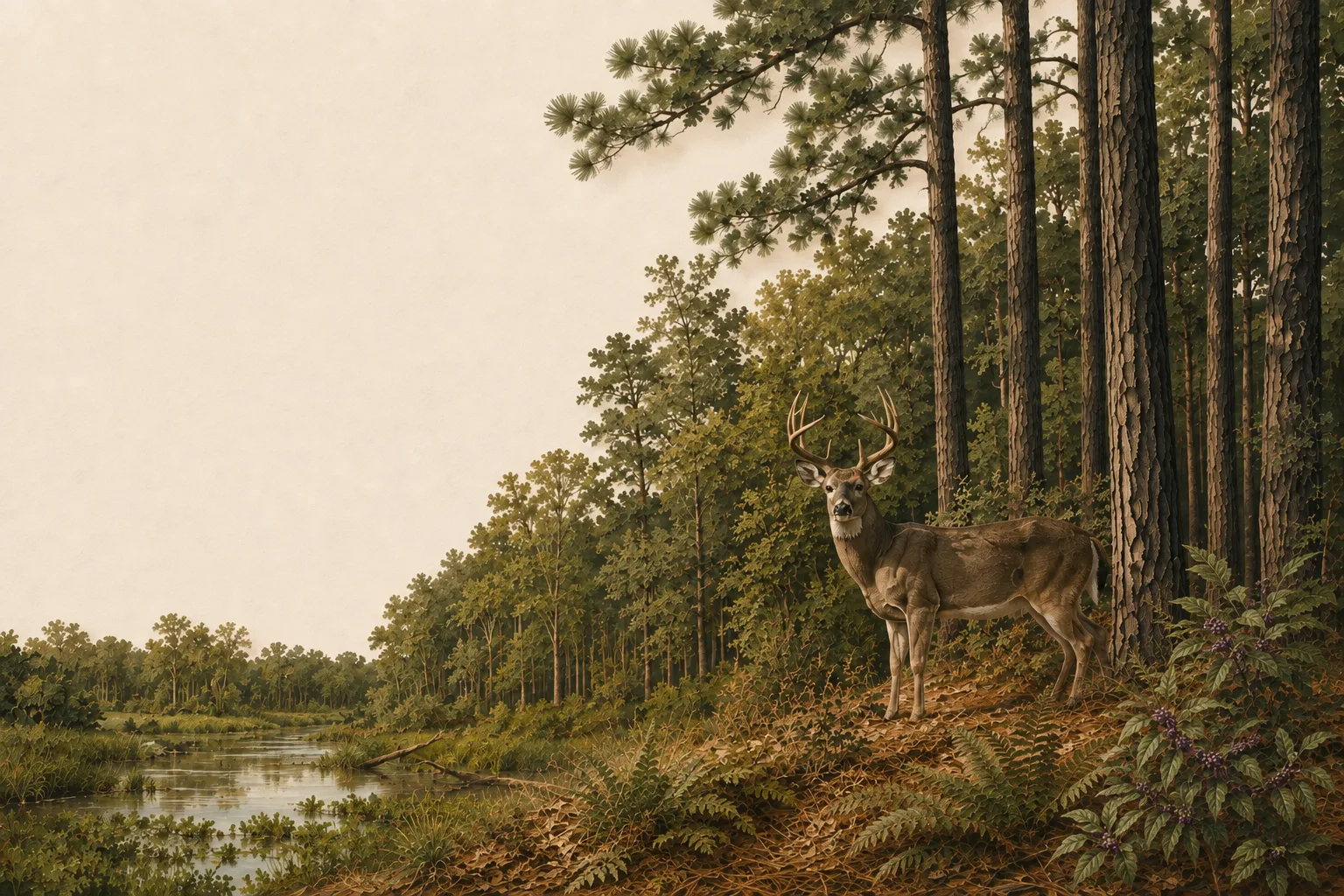
The Pineywoods of East Texas is a landscape of loblolly and shortleaf pine uplands, hardwood bottoms, and creek sloughs. Many properties here transition from timber production (1-d-1 timber use) to wildlife management, and practices tend to focus on forest structure — thinning, openings, and midstory control that let sunlight reach the forest floor.

Deer densities in the Pineywoods are moderate but rising, and eastern wild turkey restoration is a major TPWD priority — habitat work for turkeys is well received on management plans in this region. Typical target species for plans in this region include white-tailed deer, eastern wild turkey, wood ducks, gray squirrels, and neotropical migrant songbirds.

What limits wildlife here

A wildlife management plan is most convincing when it takes on the problems that actually constrain wildlife in its region rather than listing generic good deeds. In the Pineywoods, those are closed-canopy pine stands with little understory forage, invasive Chinese tallow, and feral hogs in creek bottoms — and each one is a practice waiting to be written down. A plan that names a real local problem, commits to work at regional intensity, and documents it is the plan that gets approved and stays approved.

Start with three

You need at least three of the seven qualifying practices each year under Texas Tax Code §23.51(7). For most Pineywoods landowners the natural opening three are habitat control, supplemental water and census counts: habitat control is where the real management happens, water is the quickest to install and the easiest to photograph, and a census generates dated evidence every single year. You can change which three you run as the land changes — the statute asks for three practices performed and documented, not three particular practices forever.

The seven practices, Pineywoods-style

Every Texas plan draws from the same seven practices. What changes by region is what each one looks like — and a plan that describes the wrong version for its ecoregion is the fastest way to draw questions from a chief appraiser. Here is what each practice means in the Pineywoods:

1

Habitat control

Thinning pine stands to 50–60 sq ft of basal area, creating forest openings of 1–5 acres, controlling Chinese tallow and privet, and prescribed burning on a 3-year rotation.

2

Erosion control

Establishing streamside management zones along creeks, water bars on woods roads, and re-vegetating log landings and skid trails.

3

Predator control

Feral hog trapping in bottomlands, nest predator management (raccoons, opossums) around turkey and wood duck nesting habitat, and cowbird control.

4

Supplemental water

Constructing shallow seasonal wetlands, protecting sloughs and beaver ponds, and adding wildlife ramps to ponds.

5

Supplemental food

Planting fall food plots of wheat and clover in forest openings, releasing native oaks from pine competition to boost acorn production, and managing soft-mast species like American beautyberry.

6

Providing shelter

Retaining snag trees for cavity nesters, installing wood duck boxes on sloughs, and keeping brushy edge cover along openings.

7

Census counts

Trail camera deer surveys in late summer, gobbler call counts in spring, and browse surveys on greenbrier and other key deer forage.

The acreage rule across the Pineywoods

The ecoregion decides your species and practices. It does not decide your acreage — that comes from a second, legal map: the twelve wildlife appraisal regions of 34 TAC §9.2002. The 30 counties of the Pineywoods fall into 2 of them, so two counties that share every word of their practice standards can carry different minimums:

Wildlife appraisal regions and acreage bands covering the Pineywoods ecoregion
TPWD wildlife appraisal regionAcreage bandPineywoods counties
Pineywoods 12.5–16.7 acres 92–94% 29 — Angelina, Bowie, Camp, Cass, Cherokee, Gregg, and 23 more
Post Oak Savannah 12.5–16.7 acres 92–94% 1 — Titus

None of it applies unless the tract was reduced in size since January 1 of the preceding year. If it was, the minimum is 12.5–16.7 acres, and 5 of the 30 districts here have published the exact figure they adopted. See the county-by-county table →

Every Pineywoods county

30 counties, each with its appraisal district, filing calendar, and local acreage answer:

Pineywoods questions

Pineywoods wildlife management FAQ

What are the wildlife management intensity standards for the Pineywoods?
TPWD publishes Comprehensive Wildlife Management Planning Guidelines for each ecoregion, and your appraisal district measures your plan against the Pineywoods edition. Intensity is the part landowners underestimate: it is not enough to name a practice, you have to do it at the scale the region expects — a stated number of brush acres, water sites, nest structures or survey nights, sustained annually. The seven worked examples above are written at that scale. The practical test is whether a chief appraiser reading your plan can tell how much of each practice you committed to, and whether your records show you did it.
Which species should a Pineywoods wildlife management plan target?
Whatever you name, it has to be indigenous — Texas Tax Code §23.51(7) qualifies land used to sustain a breeding, migrating or wintering population of native wild animals, and that is the species test that decides qualification. In the Pineywoods, plans are usually built around white-tailed deer, eastern wild turkey, wood ducks, gray squirrels, and neotropical migrant songbirds. Deer densities in the Pineywoods are moderate but rising, and eastern wild turkey restoration is a major TPWD priority — habitat work for turkeys is well received on management plans in this region. Introduced species are the common trap, so confirm every species you name in the plan is native to Texas before you file — managing for exotics (alone) earns nothing toward your three practices.
What is the minimum acreage in the Pineywoods?
For most tracts, none at all — an acreage test applies only where the tract was reduced in size since January 1 of the preceding year. And when it does apply, it is not the ecoregion that decides it: the 30 Pineywoods counties fall into 2 different TPWD wildlife appraisal regions, whose bands run 12.5–16.7 acres. 5 of the 30 districts here have published the figure they adopted; the rest have not, and their county falls back to its band. See the figure for every county.
Which counties are in the Pineywoods?
30 of Texas's 254: Angelina, Bowie, Camp, Cass, Cherokee, Gregg, Hardin, Harrison, Houston, Jasper, Liberty, Marion, Montgomery, Morris, Nacogdoches, Newton, Panola, Polk, Rusk, Sabine, San Augustine, San Jacinto, Shelby, Smith, Titus, Trinity, Tyler, Upshur, Walker, Wood. Each has its own guide covering the appraisal district, the filing calendar, and the acreage rule as it applies there. Texas ecoregions do not follow county lines, so a county on a boundary may read as Pineywoods on one side and something else on the other — where a district's own guidance points elsewhere, follow the district.
Which three practices should a Pineywoods plan start with?
Habitat control, supplemental water, and census counts is the combination that works almost everywhere, and it works here: habitat control is where the real management happens, water is the easiest to install and photograph, and a census produces dated evidence every year without fail. In the Pineywoods that means thinning pine stands to 50–60 sq ft of basal area, creating forest openings of 1–5 acres, controlling Chinese tallow and privet, and prescribed burning on a 3-year rotation. You need three of the seven each year, and you may change which three as the land changes — the requirement is three practices performed and documented, not three particular practices forever.

Statewide answers are in the full FAQ; the eligibility page covers who qualifies.

A Pineywoods plan, in about fifteen minutes.

Start free — the builder loads this region’s species, practices and intensity standards, then keeps the seasonal work on a checklist.

No credit card required · 15 minutes to a draft plan · Cancel anytime