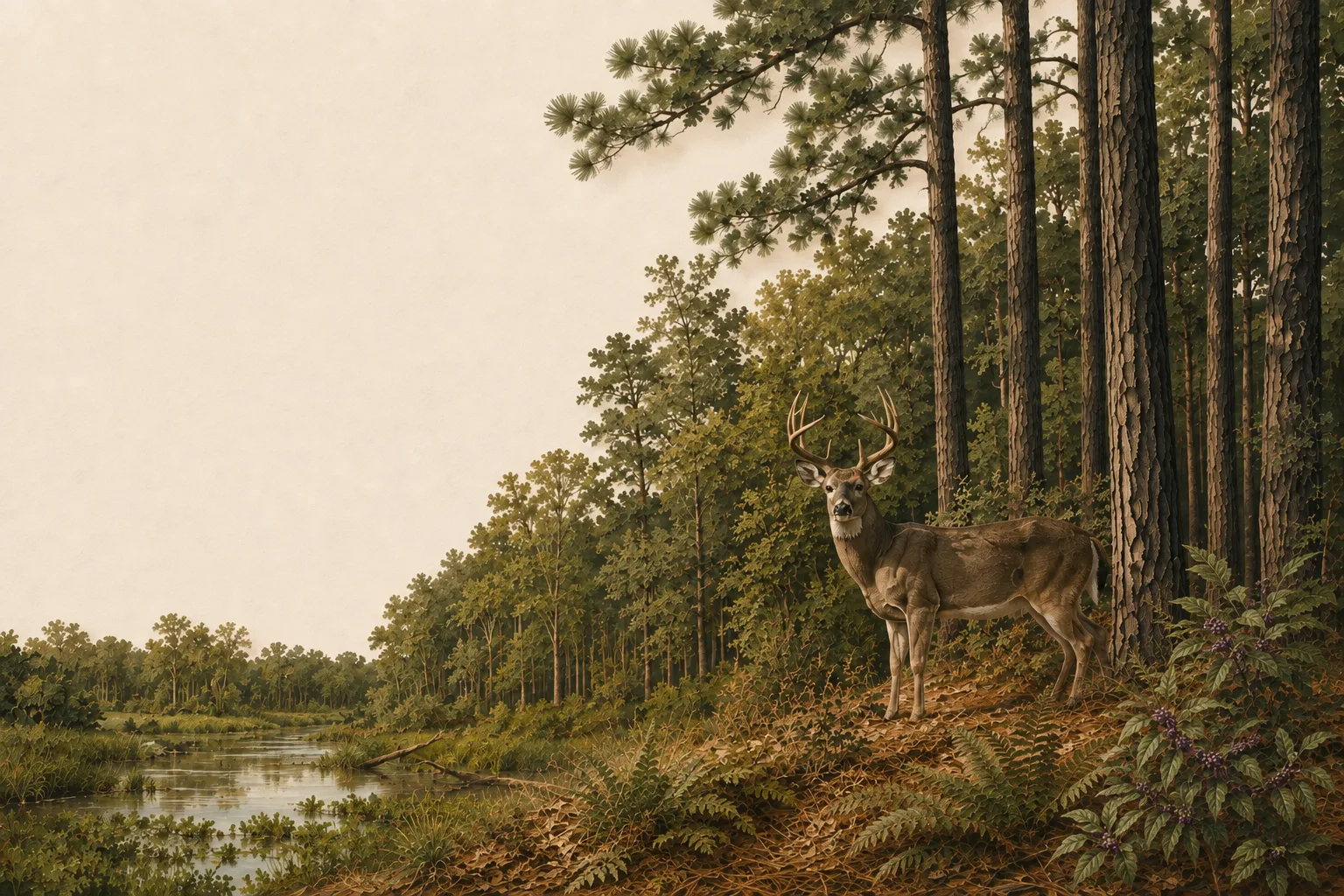
The wildlife exemption in Montgomery County
From the county seat in Conroe to the ranches beyond it, Montgomery County landowners use the wildlife exemption to keep agricultural taxes while restoring habitat for white-tailed deer and eastern wild turkey. The county's Pineywoods setting decides which practices count - and how much of them.
The Pineywoods of East Texas is a landscape of loblolly and shortleaf pine uplands, hardwood bottoms, and creek sloughs. Many properties here transition from timber production (1-d-1 timber use) to wildlife management, and practices tend to focus on forest structure - thinning, openings, and midstory control that let sunlight reach the forest floor.
Deer densities in the Pineywoods are moderate but rising, and eastern wild turkey restoration is a major TPWD priority - habitat work for turkeys is well received on management plans in this region. Typical target species for Montgomery County plans include white-tailed deer, eastern wild turkey, wood ducks, gray squirrels, and neotropical migrant songbirds. The recurring habitat challenges - closed-canopy pine stands with little understory forage, invasive Chinese tallow, and feral hogs in creek bottoms - are what a good management plan turns into qualifying work.
On the ground in Montgomery County
Conroe sits in a Pineywoods county that Houston has pushed hard into suburbia. The remaining rural tracts north and east of the metro edge still have pine-hardwood woods, creeks, wetlands and acreage-home fragmentation. Useful habitat work can use thinning, prescribed fire where feasible, native understory restoration and riparian protection to keep those properties functional. In Montgomery County, connectivity is the local issue: a smaller tract gains value when its cover and waterways still connect to something beyond the fence. That habitat pattern is the basis for wildlife management in Montgomery County.
Montgomery County lies in the Pineywoods and is assigned to TPWD's Pineywoods wildlife-use appraisal region - the legal map that sets the reduced-tract acreage rule below.
Is there an acreage minimum in Montgomery County?
Did the tract get smaller since January 1 of last year?
There is no wildlife acreage test in Montgomery County at all. Whatever the size, file Comptroller Form 50‑129 with a PWD‑885 plan. A 7-acre tract that already carried 1‑d‑1 (ag exempt) and was never split can convert with no penalties.
The Montgomery County appraisal district has not published its exact figure. However, the legal minimum land requirement for this county in the Pineywoods region is between 12.5–16.7 acres (92–94%). If your acreage is inside of this range, we recommend to file the plan either way; the county will apply whatever they adopted.
See how Montgomery County compares: minimum acreage for all 254 Texas counties →
How it works here
Montgomery County follows the statewide 1-d-1 framework (Texas Tax Code §23.51(7)); the local variables are your appraisal district's filing habits and the Pineywoods intensity standards:
- Start from an existing ag or timber valuation. Wildlife management is a conversion of qualified open-space land - check eligibility if your status is unclear.
- File a wildlife management plan (TPWD form PWD‑885) with the Montgomery County appraisal district, attached to Comptroller Form 50‑129, between January 1 and April 30. What goes in the plan →
- Perform at least 3 of the 7 practices each year at Pineywoods intensity levels - see the local examples below.
- Document everything - dates, photos, quantities. When the chief appraiser requests an annual report (PWD‑888), you'll answer with records, not recollections.
- No minimum acreage applies unless your tract got smaller since January 1 of last year. If it did, Montgomery County's figure is covered above - the district picks one number for the whole county, and the plan is still the application either way.
The 7 practices, Pineywoods-style
These are the kinds of activities appraisal districts in the Pineywoods recognize as real management - your plan picks at least three. The Pineywoods region guide covers the species, habitat problems and intensity standards behind them.
