Before you start: confirm three things
- Current 1-d-1 status. The land must hold an open-space ag (or timber) valuation now - check your appraisal notice or county property search. Conversion continues a valuation; it can’t resurrect one. (Lost it? Here’s the requalification path.)
- Tract size history. Same size as last January 1 → no minimum acreage. Recently reduced → your county’s wildlife-use ratio applies; verify the minimum before investing weekends.
- Your capacity. Three practices, done at real intensity, every year. For most owners that’s 8–15 easy field days annually. Decide you’ll actually do them.
The conversion timeline
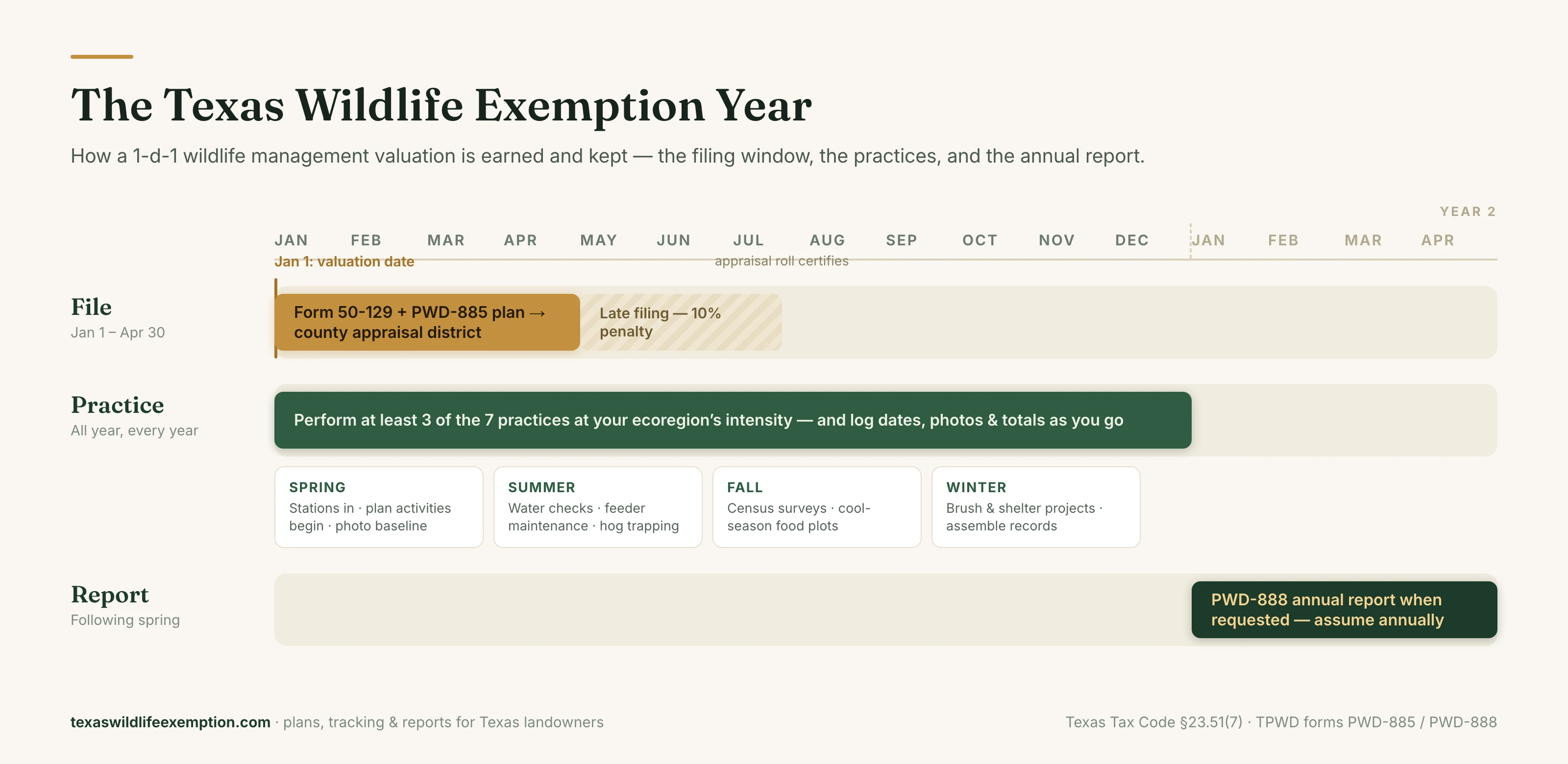
| When | Action |
|---|---|
| Fall – winter | Draft your PWD‑885 plan: target species, 3+ practices, ecoregion intensities. Keep any existing ag use running until approval is secure. |
| Jan 1 | New valuation year begins - the year you’ll qualify under wildlife use. |
| Jan 1 – Apr 30 | File Form 50‑129 (marked for wildlife management) + PWD‑885 with the county appraisal district. |
| Immediately after filing | Begin practices and log everything - your first PWD‑888 will cover this year. |
| Spring – summer | Respond promptly to any CAD questions; adjust the plan if the district requests changes. |
| Following Jan – Apr | First PWD‑888 annual report if requested (assume it will be). |
Choosing your first three practices
Pick for documentability and fit, not ambition. The combinations we see succeed most often:
- Supplemental food + supplemental water + census - the “starter kit”: feeders, a waterer or trough conversion, and a fall camera survey. Highly countable, photogenic, obviously real.
- Habitat control + shelter + census - for brush-heavy land: targeted cedar/mesquite work, brush piles from the slash, surveys to show response.
- Predator control + food + water - where hogs are the story (they usually are): trapping program with removal counts plus the standbys.
Whatever you choose, your ecoregion’s intensity standards decide the “how much.” Your county page lists typical expectations; the app turns them into a task calendar.
What happens to the cows?
Keep qualifying ag use in place through the year before conversion - you need continuous 1-d-1 status. The cleanest sequence: run the current use through December 31, file the conversion in the new window, transition the land as your wildlife practices ramp up. Don’t create a gap year with neither cattle nor an approved wildlife use.
Three conversion killers
1) Missing April 30 (late filing costs a 10% penalty; missing certification costs the year). 2) Letting ag use lapse the year before filing. 3) Filing a borrowed plan the land can’t deliver - the first PWD‑888 exposes it.
First-year rhythm (the part nobody tells you)
- Spring: stations in, plan activities begun, photo baseline taken.
- Summer: water checks (this is Texas - water is the practice that matters most in July), feeder maintenance, hog trapping.
- Fall: census season - camera or spotlight survey; food plots if planned.
- Winter: brush work and shelter projects; assemble your annual report.
Follow that rhythm and your conversion year ends with a dense, dated activity log - which is to say, with your valuation safe.
Shortcut
The app runs this entire playbook for your property: eligibility, plan, filing packet, seasonal tasks, and the first annual report. Start free →
Sources & further reading
- Comptroller Form 50-129 (PDF) - Application for 1-d-1 Open-Space Appraisal - the application your PWD-885 attaches to
- Form PWD-885 (PDF) - Wildlife Management Plan - the current TPWD form itself
- TPWD: Agricultural Tax Appraisal Based on Wildlife Management Use - the state hub for wildlife-use valuation, including the regional Comprehensive Wildlife Management Planning Guidelines
- Comptroller: Agricultural & Timber Appraisal - current manuals and wildlife-use qualification guidelines
