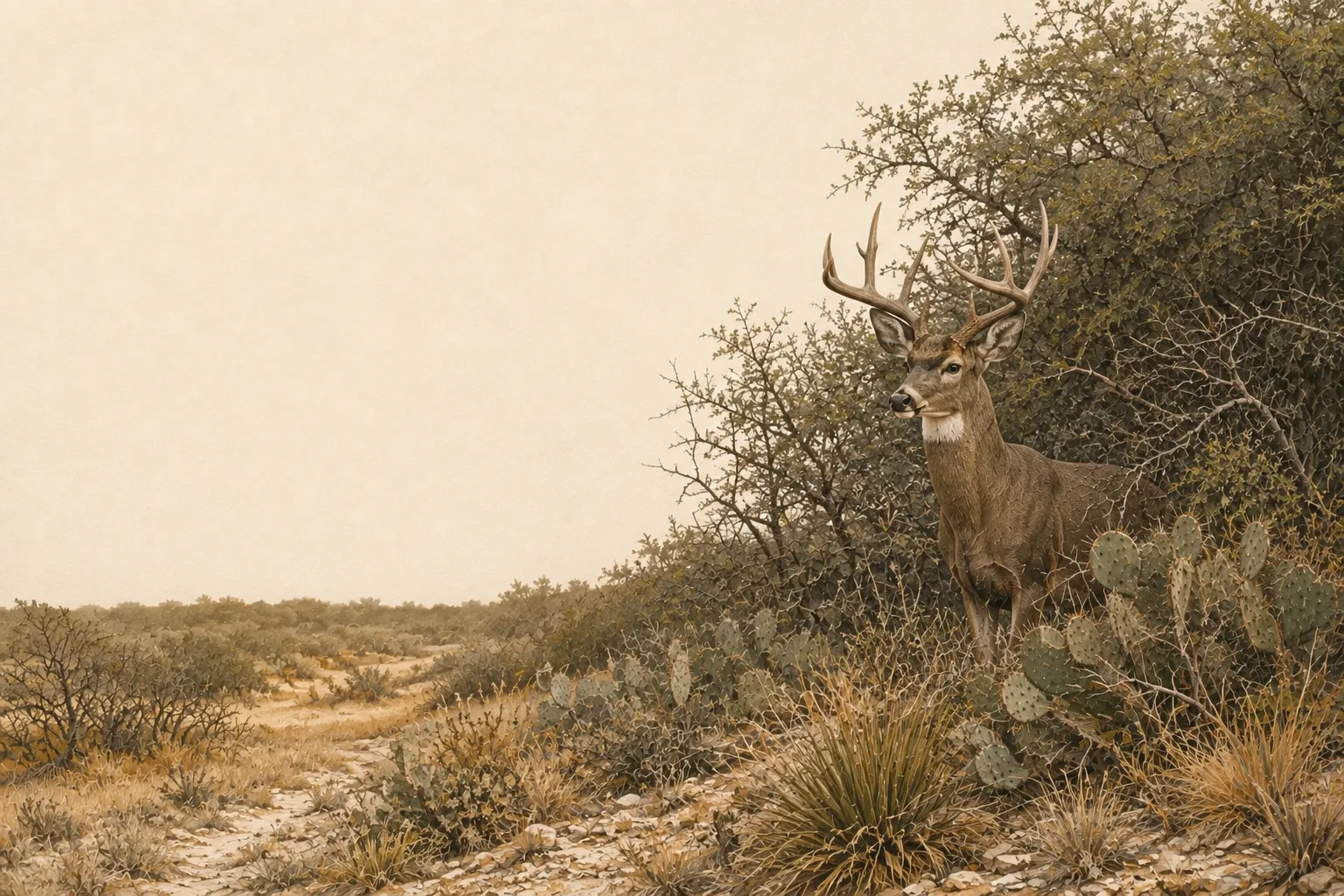
The wildlife exemption in Kleberg County
In Kleberg County, more landowners convert to wildlife management every year - keeping the low taxes of an ag valuation while managing white-tailed deer and bobwhite quail instead of cattle. The county lies in the South Texas Plains ecoregion, and that shapes exactly what your management plan should look like.
The South Texas Plains - the Brush Country - is a dense thornscrub of mesquite, blackbrush, and granjeno south of San Antonio, home to the most famous white-tailed deer genetics in America and the ranching culture that manages them. Wildlife management is a way of life here, and appraisal districts see some of the most sophisticated plans in the state.
South Texas grows the biggest whitetails in the state on native thornscrub browse; strip-pattern brush management that keeps 40–60% canopy is the signature habitat practice of the region. Typical target species for Kleberg County plans include trophy white-tailed deer, bobwhite quail, Rio Grande turkey, javelina, chachalacas in the Valley, and ocelots in remnant thornscrub. The recurring habitat challenges - buffelgrass monocultures displacing native forage, drought cycles, and clearing that removes too much thermal cover - are what a good management plan turns into qualifying work.
On the ground in Kleberg County
Kingsville sits in country shaped by the King Ranch, Santa Gertrudis Creek and a coastal sand plain that runs toward Baffin Bay. Kleberg County can hold South Texas thornscrub, native grassland, farm ground, wetlands and Gulf influence on the same broad landscape. The wildlife management program can therefore blend patterned brush for deer and quail with native-grass restoration, water, wetland protection and bird census work. A local plan should embrace that brush-to-coast gradient rather than forcing the property into either a pure ranch or pure marsh description.
Kleberg County reads as South Texas Plains habitat on the ground, but TPWD assigns it to the Gulf Prairies and Marshes (Lower Coast) wildlife-use appraisal region for reduced-tract acreage rules - two different maps, and the legal one controls the numbers below.
Is there an acreage minimum in Kleberg County?
Did the tract get smaller since January 1 of last year?
There is no wildlife acreage test in Kleberg County at all. Whatever the size, file Comptroller Form 50‑129 with a PWD‑885 plan. A 7-acre tract that already carried 1‑d‑1 (ag exempt) and was never split can convert with no penalties.
The Kleberg County appraisal district has published its figure. The legal minimum land requirement is 50 acres. Wildlife management property associations: 20 acres.
Source: Kleberg County Appraisal District Agricultural Standards (2024 Degree of Intensity Standards), 2023.
See how Kleberg County compares: minimum acreage for all 254 Texas counties →
How it works here
Kleberg County follows the statewide 1-d-1 framework (Texas Tax Code §23.51(7)); the local variables are your appraisal district's filing habits and the South Texas Plains intensity standards:
- Start from an existing ag or timber valuation. Wildlife management is a conversion of qualified open-space land - check eligibility if your status is unclear.
- File a wildlife management plan (TPWD form PWD‑885) with the Kleberg County appraisal district, attached to Comptroller Form 50‑129, between January 1 and April 30. What goes in the plan →
- Perform at least 3 of the 7 practices each year at South Texas Plains intensity levels - see the local examples below.
- Document everything - dates, photos, quantities. When the chief appraiser requests an annual report (PWD‑888), you'll answer with records, not recollections.
- No minimum acreage applies unless your tract got smaller since January 1 of last year. If it did, Kleberg County's figure is covered above - the district picks one number for the whole county, and the plan is still the application either way.
The 7 practices, South Texas Plains-style
These are the kinds of activities appraisal districts in the South Texas Plains recognize as real management - your plan picks at least three. The South Texas Plains region guide covers the species, habitat problems and intensity standards behind them.
